Construction projects are a familiar part of life in American cities and communities. New buildings, road improvements, commercial renovations, apartment developments, and infrastructure repairs frequently bring construction activity into areas where pedestrians walk every day. Although construction is essential for maintaining and improving public spaces, active job sites can create serious hazards for people who have no involvement in the work taking place.
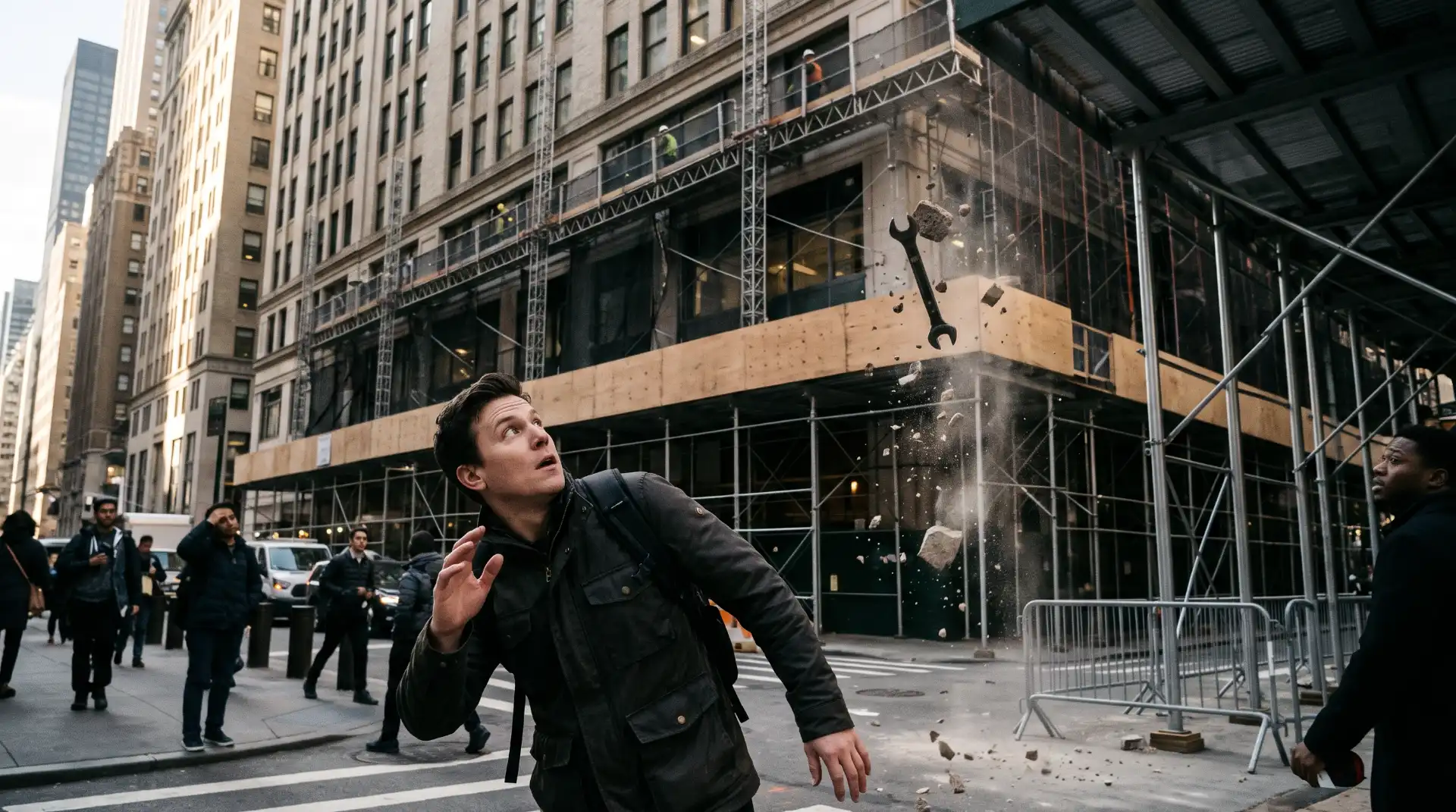
One particularly dangerous hazard is falling construction debris. A hammer dropped from scaffolding, a loose brick falling from an unfinished wall, a piece of metal dislodged during demolition, or construction materials improperly stored near an elevated edge can cause devastating injuries to someone walking below. Even relatively small objects can become dangerous when they fall from several stories above the ground.
Pedestrians generally have little warning when an object falls from a construction site. Unlike a vehicle approaching an intersection, falling debris may come from outside a person’s field of vision. A pedestrian might be looking ahead, checking a traffic signal, speaking with another person, or simply walking along a sidewalk without realizing that workers are performing overhead operations.
These accidents can result in traumatic brain injuries, skull fractures, spinal cord damage, severe lacerations, broken bones, permanent disabilities, and even death.
When a pedestrian is injured by falling construction materials, an important legal question arises: Who is responsible for preventing the accident?
Depending on the circumstances, liability may involve a property owner, general contractor, subcontractor, construction company, maintenance company, equipment operator, or another party responsible for creating or controlling the dangerous condition. In some cases, several parties may share responsibility.
Understanding how construction site liability works can help injured pedestrians and their families identify potential legal claims, preserve important evidence, and understand the compensation that may be available under applicable state law.
Correction: The earlier partial text referred to nighttime pedestrian accidents by mistake. Please disregard it. The complete article below addresses falling objects at construction sites, as requested.
Pedestrian Accidents Caused by Falling Objects at Construction Sites: Can Property Owners and Contractors Be Held Liable?
Construction projects are a familiar part of life in American cities and communities. New buildings, road improvements, commercial renovations, apartment developments, and infrastructure repairs frequently bring construction activity into areas where pedestrians walk every day. Although construction is essential for maintaining and improving public spaces, active job sites can create serious hazards for people who have no involvement in the work taking place.
One particularly dangerous hazard is falling construction debris. A hammer dropped from scaffolding, a loose brick falling from an unfinished wall, a piece of metal dislodged during demolition, or construction materials improperly stored near an elevated edge can cause devastating injuries to someone walking below. Even relatively small objects can become dangerous when they fall from several stories above the ground.
Pedestrians generally have little warning when an object falls from a construction site. Unlike a vehicle approaching an intersection, falling debris may come from outside a person’s field of vision. A pedestrian might be looking ahead, checking a traffic signal, speaking with another person, or simply walking along a sidewalk without realizing that workers are performing overhead operations.
These accidents can result in traumatic brain injuries, skull fractures, spinal cord damage, severe lacerations, broken bones, permanent disabilities, and even death.
When a pedestrian is injured by falling construction materials, an important legal question arises: Who is responsible for preventing the accident?
Depending on the circumstances, liability may involve a property owner, general contractor, subcontractor, construction company, maintenance company, equipment operator, or another party responsible for creating or controlling the dangerous condition. In some cases, several parties may share responsibility.
Understanding how construction site liability works can help injured pedestrians and their families identify potential legal claims, preserve important evidence, and understand the compensation that may be available under applicable state law.
Why Falling Objects at Construction Sites Are a Serious Pedestrian Safety Hazard
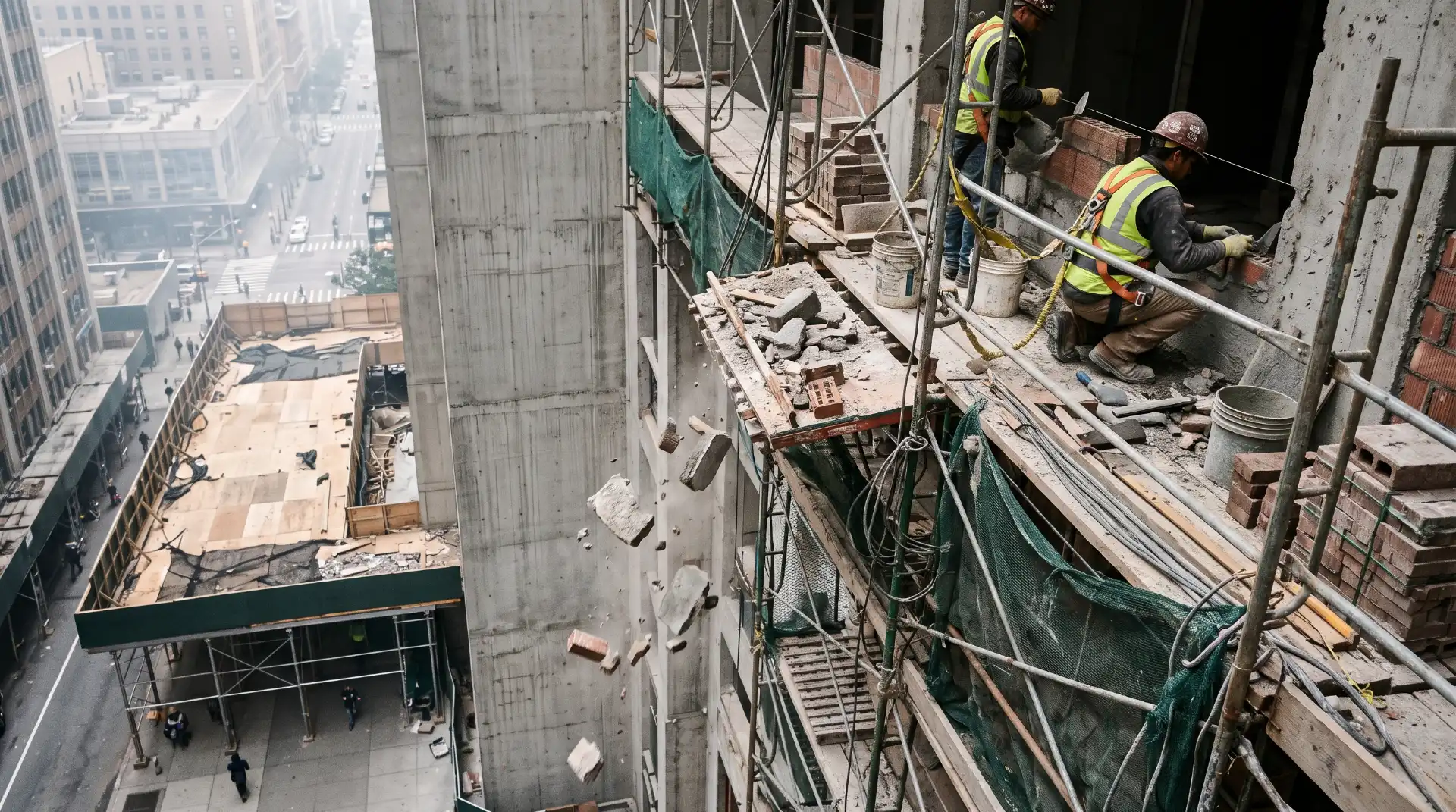
Construction sites frequently involve activities performed at different elevations. Workers may install roofing materials, repair exterior walls, assemble scaffolding, operate cranes, move building supplies, replace windows, remove structural components, or perform demolition work several stories above street level.
These activities create opportunities for objects to become dislodged and fall into areas occupied by pedestrians.
A construction site may appear properly organized from the sidewalk while still presenting overhead hazards. Materials can be stacked near an exposed edge, tools can be left unsecured on scaffolding, and demolition debris can escape through an inadequately protected opening. Strong winds, vibrations, equipment movement, and careless handling can make these conditions even more dangerous.
The risk becomes especially serious when construction work takes place directly above a public sidewalk, pedestrian crossing, building entrance, parking area, or frequently traveled commercial district.
Common Objects That Fall From Construction Sites
Falling construction objects vary considerably in size, weight, and shape. Some may cause relatively minor injuries, while others can produce catastrophic trauma.
Common examples include:
-
Bricks, concrete fragments, and pieces of masonry.
-
Hammers, drills, wrenches, and other construction tools.
-
Metal pipes, steel components, and loose fasteners.
-
Roofing materials, shingles, and wooden boards.
-
Glass panels, window frames, and building fixtures.
-
Scaffolding components and temporary structural materials.
-
Demolition debris, tiles, and broken building materials.
-
Equipment attachments and materials being lifted by cranes.
A small metal tool falling from a significant height can cause a serious head injury. A heavy concrete fragment may cause multiple fractures or internal injuries. Large pieces of glass can produce deep lacerations and permanent disfigurement.
Even lightweight materials can become dangerous when wind carries them from elevated work areas into pedestrian spaces.
Why Urban Construction Projects Create Additional Risks
Urban construction projects frequently operate in locations where pedestrians have limited room to move around the work area. Sidewalks may be narrowed by temporary fencing, construction equipment, scaffolding, storage containers, and delivery vehicles.
In some situations, pedestrians are directed through temporary walkways located close to active construction operations. If overhead protection is missing or improperly installed, people using these routes may be exposed to falling materials.
Commercial districts create additional concerns because pedestrians may include shoppers, restaurant customers, tourists, delivery workers, children, and people with disabilities. Many individuals may be unfamiliar with the construction site and unaware of the hazards occurring above them.
Construction companies and property owners must consider how their activities affect people outside the job site, not simply the safety of employees working inside it.
How Falling Construction Objects Cause Pedestrian Injuries
The severity of a falling-object injury depends on several factors, including the object’s weight, shape, height, speed, and point of impact.
An object falling from a rooftop can gain considerable speed before reaching the ground. When it strikes a pedestrian, the force may be concentrated on a relatively small area of the body.
The head, neck, shoulders, back, and upper body are particularly vulnerable because pedestrians generally have no protective equipment or physical barrier between themselves and the falling object.
Traumatic Brain Injuries and Skull Fractures
Head injuries are among the most serious consequences of falling construction debris. A brick, metal tool, concrete fragment, or other heavy object striking someone’s head can cause a concussion, skull fracture, or traumatic brain injury.
A traumatic brain injury may affect memory, concentration, coordination, speech, emotional regulation, and the ability to perform ordinary activities.
Some victims recover after a relatively short period, while others experience long-term cognitive problems requiring extensive rehabilitation and continuing medical care.
Severe injuries may prevent individuals from returning to work or living independently. Families may also experience significant financial and emotional difficulties when a loved one requires ongoing supervision or assistance.
Spinal Cord and Neck Injuries
A falling object can strike the neck, shoulders, or back, producing injuries that affect the spinal column and surrounding tissues.
Depending on the location and severity, a victim may experience herniated discs, fractured vertebrae, nerve damage, or spinal cord injuries.
Serious spinal trauma can cause chronic pain, reduced mobility, weakness, numbness, and, in the most severe cases, partial or complete paralysis.
These injuries may require surgery, physical therapy, specialized rehabilitation, and assistive devices.
Broken Bones and Severe Fractures
Heavy construction materials can fracture bones when they strike a pedestrian directly. Common injuries include broken arms, wrists, shoulders, ribs, legs, and facial bones.
A victim may also suffer secondary injuries after falling to the pavement while attempting to avoid or reacting to the impact.
Complex fractures can require surgical plates, screws, rods, and extended rehabilitation. Some injuries may result in permanent limitations affecting walking, lifting, driving, or returning to employment.
Eye Injuries and Permanent Vision Damage
Small fragments of concrete, metal, glass, and other construction materials can injure a pedestrian’s eyes.
Depending on the material and impact, injuries may include corneal abrasions, penetrating eye injuries, retinal damage, and permanent vision loss.
Even when the falling object does not strike someone directly, airborne dust and debris produced by construction or demolition work may create additional hazards for people walking nearby.
Internal Injuries and Psychological Trauma
A heavy object striking the torso can cause internal bleeding, organ damage, and injuries that may not be immediately apparent.
Victims may initially focus on visible wounds while more serious internal injuries develop or become noticeable later.
The psychological consequences can also be significant. People involved in serious construction-related accidents may experience anxiety, sleep disturbances, depression, fear of crowded sidewalks, or symptoms associated with post-traumatic stress.
A complete injury evaluation should consider both immediate physical damage and the possibility of long-term medical and psychological consequences.
Who Can Be Held Liable for a Pedestrian Accident Caused by Falling Construction Objects?
Determining liability is often one of the most complicated aspects of a construction-related pedestrian injury claim.
Unlike a typical vehicle accident involving two drivers, construction projects may involve several businesses and individuals performing different responsibilities at the same location.
The property owner may have hired a general contractor, which then hired subcontractors responsible for scaffolding, demolition, roofing, electrical installations, or exterior repairs. Equipment rental companies and material suppliers may also have roles in the project.
The presence of multiple parties does not automatically make every company responsible. Liability generally depends on the specific duties each party owed, the conduct that contributed to the accident, and the applicable state law.
Property Owners and Premises Liability
Property owners may face liability when dangerous conditions on their property create an unreasonable risk of harm to pedestrians.
Under premises liability principles, owners may have duties to maintain reasonably safe conditions and address hazards that they create, know about, or should discover through reasonable inspection.
For example, imagine a commercial property owner authorizes exterior renovations while allowing pedestrians to continue using the sidewalk immediately below the work area. If the owner knows that heavy materials are being stored near an exposed edge but fails to address the danger, the owner’s conduct may become relevant to a negligence claim.
Similarly, an apartment building owner may be questioned if the owner knew that a contractor was performing overhead repairs without adequate pedestrian protection.
However, property ownership alone does not automatically establish liability. Courts generally examine the owner’s actual control over the premises, knowledge of the hazard, contractual arrangements, and ability to take reasonable precautions.
Some property owners delegate construction operations to independent contractors. Depending on the jurisdiction and circumstances, that arrangement may limit certain forms of liability, but it does not necessarily eliminate every potential claim.
For example, an owner who actively controls the dangerous work, creates an unsafe condition, negligently selects a contractor in circumstances where the law recognizes a duty, or retains responsibility for particular safety measures may face additional legal scrutiny.
General Contractors and Construction Companies
General contractors frequently coordinate construction activities, manage schedules, supervise subcontractors, and establish jobsite safety procedures.
Because of these responsibilities, a general contractor may become an important defendant when a pedestrian is injured by falling materials.
Potential negligence may include failing to establish adequate overhead protection, allowing unsecured materials to remain near exposed edges, permitting unsafe demolition practices, or failing to coordinate work occurring above pedestrian walkways.
Consider a situation in which a general contractor allows several subcontractors to work on different levels of a building. One subcontractor performs exterior repairs while another transports materials overhead. If the contractor fails to coordinate these activities or address an obvious falling-object hazard, the contractor’s conduct may contribute to an accident.
The exact responsibility depends on the construction agreement, the contractor’s retained authority, the safety procedures in place, and the applicable state law.
A general contractor cannot necessarily avoid responsibility simply by arguing that a subcontractor performed the activity that caused the injury. The investigation must determine whether the general contractor independently contributed to the dangerous condition or had a legally recognized duty to prevent it.
Subcontractors Performing Construction Work
Subcontractors often perform specialized activities that create specific falling-object risks.
Roofing companies, demolition contractors, masonry workers, window installers, steel erectors, and scaffolding contractors may all handle materials at elevated locations.
A subcontractor may be liable if its employees carelessly drop tools, improperly secure building materials, leave debris near an exposed edge, or fail to follow reasonable safety procedures.
For example, a masonry subcontractor performing exterior repairs may leave loose bricks on a scaffold platform. If a brick falls onto a pedestrian below, the subcontractor’s handling and storage practices may become central issues in the liability investigation.
A subcontractor may also face responsibility when it creates a dangerous condition that another contractor or the property owner could not reasonably anticipate.
The fact that a company was hired by a general contractor does not automatically protect it from claims brought by injured members of the public.
Scaffolding and Equipment Companies
Scaffolding is frequently used during building construction, painting, window replacement, exterior maintenance, and renovation projects.
Improperly assembled or maintained scaffolding can create falling-object hazards. Loose boards, unsecured components, inadequate protective screens, and unstable platforms may allow materials to fall into areas below.
The company responsible for installing, inspecting, maintaining, or modifying scaffolding may become relevant when an accident results from a defect or improper setup.
Equipment manufacturers and rental companies may also face potential liability when a defective component contributes to an accident.
For example, a defective locking mechanism could cause a platform component to detach during normal use. A product liability investigation may then examine whether the equipment contained a manufacturing defect, design defect, or inadequate safety warnings.
These claims require technical evidence and a clear connection between the alleged defect and the pedestrian’s injury.
Construction Site Safety Regulations and Falling Object Protection
Construction companies operating in the United States must comply with applicable federal and state safety requirements. These regulations are important because they establish recognized precautions for reducing hazards associated with elevated work, scaffolding, demolition, material storage, and falling objects.
The Occupational Safety and Health Administration (OSHA) administers federal workplace safety standards, including requirements that address falling-object hazards.
One particularly relevant regulation is 29 CFR § 1926.501(c), which addresses protection from falling objects. It requires employers to provide hard hats to exposed employees and implement protective measures such as toeboards, screens, guardrail systems, protective canopies, or barricaded exclusion areas, as applicable to the circumstances.
OSHA’s requirements are designed primarily to protect workers. However, they can also provide useful evidence when investigating whether a construction company followed recognized safety practices around an active jobsite.
The regulation can be reviewed through the official OSHA construction fall protection standards.
The Importance of Overhead Protection
Overhead protection is particularly important when construction activities take place above sidewalks or other pedestrian areas.
Depending on the work and site conditions, protective measures may include:
-
Properly installed overhead canopies and covered pedestrian walkways.
-
Protective screens and debris netting around scaffolding.
-
Toeboards and guardrail systems designed to prevent materials from falling.
-
Secure storage areas for tools and construction materials.
-
Barricades that prevent public access to dangerous areas.
-
Controlled lifting and transportation of materials.
-
Regular inspections of scaffolding and elevated work platforms.
A protective canopy must be appropriately designed for the hazards it is intended to address. A lightweight covering that cannot withstand the impact of falling construction materials may provide a false sense of security.
Similarly, debris netting should not be treated as a complete substitute for securing heavy tools and building materials. Different hazards require different protective measures.
OSHA Standards Addressing Falling Materials
OSHA’s construction regulations contain additional requirements concerning elevated work and falling-object protection.
For example, 29 CFR § 1926.502(j) establishes criteria for certain protective systems, including toeboards, guardrails, and canopies. It also addresses the positioning and storage of materials during particular construction activities.
Section 1926.759 contains additional falling-object requirements for steel erection operations, including securing tools and materials that are not in use while elevated.
These provisions help demonstrate that falling-object hazards are recognized construction safety concerns rather than unexpected events that cannot reasonably be prevented.
Nevertheless, an important legal distinction must be understood: OSHA regulations generally establish workplace safety obligations owed by employers to employees. A pedestrian injured outside the construction site does not automatically obtain a private lawsuit simply because an OSHA regulation was violated.
Instead, OSHA standards and related safety evidence may help an attorney, expert, or court evaluate whether the conduct of a responsible party fell below the applicable standard of care. Whether a regulatory violation establishes negligence, supports an inference of negligence, or is otherwise admissible depends on state law and the circumstances.
Can an OSHA Violation Help Prove Negligence?
An OSHA violation may become relevant evidence in a civil personal injury case, but its legal significance varies.
Some jurisdictions allow certain regulatory violations to support a negligence-per-se argument when the requirements of the applicable law are satisfied. Other jurisdictions treat regulatory violations as evidence of negligence rather than automatic proof of liability.
The court may consider whether the regulation applies to the activity, whether the injured person falls within a legally protected class, whether the injury is the type the regulation was intended to prevent, and whether the violation contributed to the accident.
An attorney may also examine inspection records, OSHA citations, safety manuals, prior incident reports, and construction-site inspection documents.
A violation does not necessarily prove that a particular company caused the accident. The claimant must still establish the necessary connection between the defendant’s conduct and the injury.
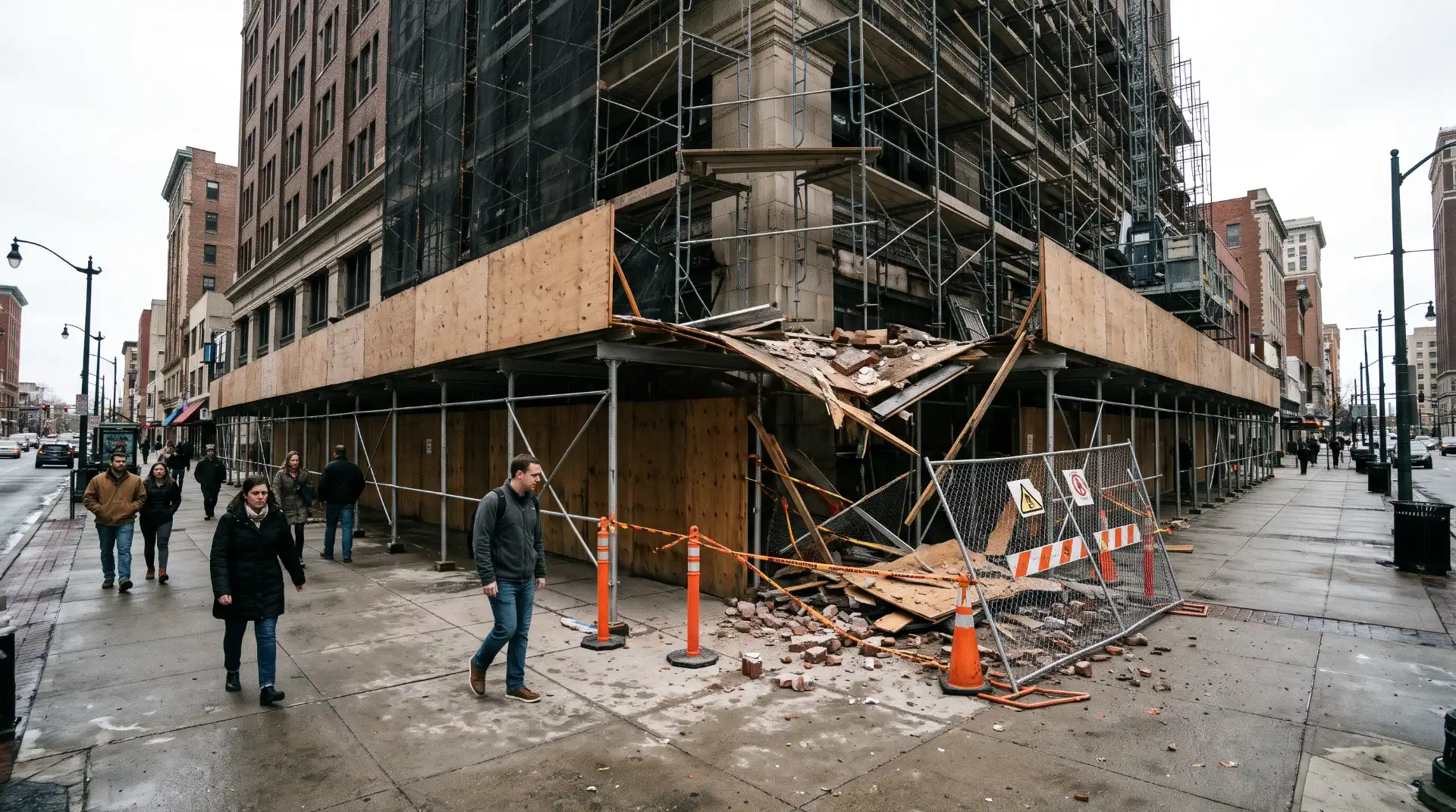
Negligence Claims Involving Falling Construction Debris
Most pedestrian injury lawsuits involving falling construction objects are based on negligence or another recognized legal theory.
Negligence generally involves a duty of reasonable care, a breach of that duty, causation, and actual damages.
These elements provide a framework for evaluating whether a property owner, contractor, subcontractor, or another party should be legally responsible.
Establishing a Duty of Care
The first question is whether the defendant owed the injured pedestrian a legal duty.
Property owners may owe duties to people who lawfully use adjoining walkways or enter their premises, depending on the circumstances and applicable premises liability rules.
Contractors and subcontractors may also owe duties when their construction activities create foreseeable risks to members of the public.
For example, a contractor performing demolition work above a busy sidewalk should reasonably anticipate that unsecured debris could injure pedestrians.
The duty analysis may become more complicated when a contractor is an independent business hired by a property owner. Courts consider the relationship between the parties, control over the work, statutory requirements, and applicable exceptions to independent-contractor liability rules.
Proving a Breach of Duty
A breach occurs when a party fails to exercise the level of care required under the circumstances.
Examples may include leaving tools unsecured on scaffolding, failing to install appropriate overhead protection, allowing loose masonry to accumulate near an exposed edge, or continuing hazardous overhead operations while pedestrians use an unprotected walkway.
A contractor may also breach its duty by failing to inspect equipment, ignoring repeated reports of falling debris, or allowing workers to continue an unsafe practice after a near miss.
The investigation must identify the specific conduct that made the accident reasonably preventable.
Establishing Causation
Causation connects the defendant’s conduct to the pedestrian’s injuries.
Suppose a construction company fails to secure a metal component on an elevated platform. The component falls onto a pedestrian, causing a fractured skull and permanent neurological damage.
The injured person would generally need evidence showing that the failure to secure the component contributed to the fall and resulting injuries.
This may involve photographs, witness statements, physical evidence, engineering analysis, and construction records.
Causation can become more complicated when several companies were working at the same time or when the precise source of the falling object is initially unknown.
An experienced investigation may identify the company responsible for the particular work activity, the equipment involved, and the safety procedures that were missing or improperly followed.
Demonstrating Actual Damages
Finally, an injured pedestrian must establish legally recognized damages.
These may include emergency medical expenses, hospitalization, surgery, rehabilitation, lost wages, reduced earning capacity, pain and suffering, disability, and other losses recognized by state law.
The medical consequences of a falling-object accident can be substantial, especially when the victim suffers a permanent head injury, spinal injury, or multiple fractures.
Medical records, employment documentation, expert testimony, and evidence of everyday limitations may help establish the extent of the damages.
Can Property Owners Be Liable Even When They Hire Independent Contractors?
This is one of the most important questions in construction-related pedestrian injury litigation.
Property owners frequently hire independent contractors to perform specialized construction work. In many circumstances, a property owner is not automatically responsible for every negligent act committed by an independent contractor.
However, the independent-contractor relationship does not provide absolute protection against liability.
Depending on state law, several circumstances may create potential claims against the property owner.
Retained Control Over Construction Activities
A property owner may retain authority over certain aspects of a construction project.
For example, the owner may control when particular work takes place, determine which pedestrian areas remain accessible, approve safety procedures, or direct the contractor’s operations.
If the owner retains sufficient control over the activity that caused the accident and negligently exercises that control, the owner may face potential liability.
The legal analysis generally focuses on the actual degree of control rather than merely the language used in the construction contract.
Negligent Hiring or Contractor Selection
A property owner may also face questions about the process used to select a construction company.
For instance, an owner might hire a contractor despite knowing about a serious history of unsafe practices, inadequate qualifications, or repeated failures to follow essential safety requirements.
Whether negligent hiring creates a valid claim depends on the applicable law and the relationship between the hiring party and the contractor.
Simply hiring a company that later makes a mistake does not automatically establish negligent selection.
Dangerous Conditions Known to the Property Owner
Another important issue involves dangerous conditions that the property owner knew about or should have discovered.
Imagine that a building owner receives several complaints about construction debris falling onto the sidewalk. Rather than closing the dangerous pedestrian route or requiring additional protection, the owner allows the area to remain accessible.
If another pedestrian is subsequently injured, the earlier complaints may become important evidence of notice and foreseeability.
The owner may be questioned about what was known, what safety measures were available, and why reasonable action was not taken.
When Can a General Contractor Be Held Responsible for a Subcontractor’s Mistake?
General contractors frequently coordinate several subcontractors working simultaneously on a construction project.
One company may install windows while another repairs exterior walls. A separate subcontractor may handle roofing, scaffolding, or demolition.
This arrangement can create complicated questions about who controlled the work and who was responsible for preventing hazards.
A general contractor may face liability if its own negligent conduct contributed to the accident, even when a subcontractor physically dropped the object.
For example, a general contractor might schedule overhead demolition while allowing pedestrians to use an unprotected walkway beneath the work area. The demolition subcontractor may be responsible for the falling debris, but the general contractor’s failure to coordinate the work or establish appropriate exclusion zones could also be relevant.
Some construction contracts assign responsibility for particular safety procedures to specific contractors. However, contractual language does not necessarily eliminate duties imposed by law.
Depending on the state, courts may also recognize liability where a general contractor retains control over safety-related activities, negligently undertakes protective responsibilities, or falls within an applicable exception to the independent-contractor rule.
An investigation should therefore examine both the written construction agreements and the actual working relationships at the site.
Can a City or Government Agency Be Held Responsible?
Construction projects do not always take place entirely on private property.
Sidewalk repairs, bridge renovations, public building improvements, road construction, utility installations, and municipal infrastructure projects may involve government agencies or contractors working on public property.
When a pedestrian is injured by falling construction materials during a public project, liability may involve a government entity, a private contractor, or both.
For example, a city may authorize building repairs along a public pedestrian route. If the work area is inadequately protected and materials fall onto someone walking nearby, the investigation may examine the responsibilities of the agency overseeing the project and the contractor performing the work.
Government liability is subject to special legal requirements.
Many states impose specific notice procedures and shorter deadlines for claims involving public entities. Some jurisdictions also provide immunity for certain discretionary government decisions or particular categories of conduct.
A pedestrian may need to file an administrative claim before bringing a lawsuit. The required filing period may be considerably shorter than the ordinary personal injury statute of limitations.
For that reason, injured pedestrians should not assume they have the same filing deadline for every potential defendant.
A claim involving a private contractor may follow different procedural rules from a claim against a city, county, or state agency.
How Temporary Sidewalk Closures and Pedestrian Detours Affect Liability
Construction projects sometimes require sidewalks to be closed or temporarily redirected.
These arrangements can be necessary to protect pedestrians from overhead work, demolition, equipment movement, or other hazards.
However, a poorly designed pedestrian detour can create additional risks.
Consider a construction project that blocks a sidewalk without providing a clearly marked alternative route. Pedestrians may be forced to walk close to moving vehicles, enter an active work zone, or pass beneath an area where workers are handling materials overhead.
If a pedestrian is injured, investigators may examine whether the construction company or responsible agency provided adequate barriers, signs, lighting, and safe alternative access.
Accessibility is another important consideration.
Under applicable disability access requirements, temporary pedestrian routes may need to accommodate people who use wheelchairs, walkers, or other mobility devices. A detour that forces a pedestrian into an unsafe roadway or prevents access to essential destinations may raise additional legal concerns.
The facts of each project determine which regulations and duties apply.
A useful related resource on your website is Can Smart Crosswalk Technology Reduce Pedestrian Accidents?, which discusses pedestrian crossings, infrastructure, and potential responsibility when safety systems fail.
What Evidence Is Important After a Falling Construction Object Accident?
Evidence is often the deciding factor in construction-related pedestrian injury claims. Unlike ordinary traffic accidents, these incidents may involve several businesses, multiple levels of construction activity, and equipment that must be inspected to determine how the object became dislodged.
Some evidence may disappear within hours or days. Construction companies may remove debris, repair scaffolding, change protective barriers, or continue work in the area. Surveillance recordings may also be automatically deleted.
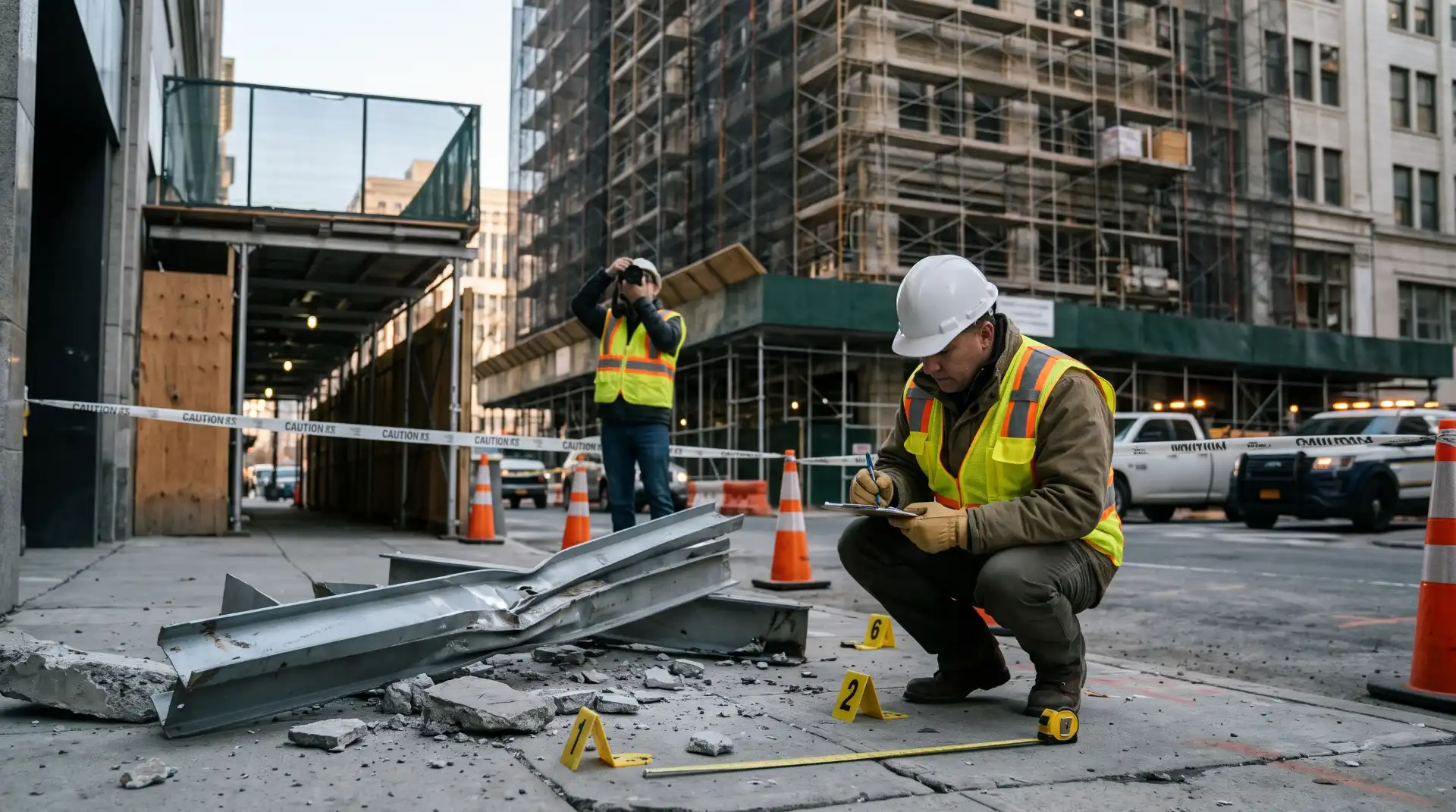
Preserving evidence early can help establish what happened and identify the parties who may be responsible.
Photographs and Videos of the Accident Scene
Photographs can document the physical conditions that existed when the accident occurred.
Important images may include the building exterior, scaffolding, construction platforms, protective netting, overhead canopies, temporary fencing, sidewalk conditions, and the location where the object landed.
Photographs should also show the surrounding pedestrian environment. A sidewalk that appears adequately protected from one angle may have an exposed section from another direction.
If the accident occurred near a business, apartment building, parking garage, or public intersection, investigators should identify possible surveillance cameras.
Video recordings may show the object falling, workers handling materials, the pedestrian’s movements, and the condition of the construction site immediately before the incident.
Because many security systems overwrite recordings automatically, preservation requests should be sent promptly.
The Actual Object That Caused the Injury
Whenever possible, the object involved in the accident should be preserved.
A damaged hammer, metal pipe, concrete fragment, loose scaffold component, or broken glass panel may provide important physical evidence.
An expert may examine the object to determine its weight, dimensions, condition, possible defects, and whether it shows signs of improper handling or equipment failure.
The object may also help establish which construction activity was taking place and which contractor was responsible for the materials.
If the object is removed by the construction company, photographs and documentation of its original location and condition may become especially important.
Construction Contracts and Project Documents
Construction contracts can help identify the companies responsible for different activities.
Important documents may include:
-
General contractor agreements.
-
Subcontractor contracts.
-
Scaffolding installation and inspection records.
-
Construction safety plans.
-
Daily jobsite inspection reports.
-
Material storage and handling procedures.
-
Equipment maintenance records.
-
Incident and near-miss reports.
-
Site-specific pedestrian protection plans.
-
Records of previous safety complaints.
These documents may reveal who was responsible for installing overhead protection, controlling public access, inspecting elevated platforms, and supervising particular construction operations.
For example, a subcontractor may have been responsible for securing materials, while the general contractor controlled sidewalk closures and public access. The documents can help clarify these responsibilities.
Witness Statements
Witnesses may include pedestrians, nearby residents, construction workers, delivery drivers, business employees, and people waiting at nearby intersections.
Their statements may help establish what happened immediately before the accident.
A witness might have seen a worker drop a tool, noticed loose materials on scaffolding, observed construction debris falling repeatedly, or heard complaints about inadequate overhead protection.
Witnesses may also describe whether warning signs or barricades were present.
It is important to obtain contact information as soon as possible because people may leave the area or become difficult to locate later.
Expert Investigations and Engineering Analysis
Some construction-related pedestrian accidents require technical investigations.
An engineering expert may inspect scaffolding, elevated platforms, protective canopies, debris netting, and material storage arrangements.
The expert may examine whether the equipment was properly installed, whether it was suitable for the work being performed, and whether the protective system was capable of preventing the particular object from reaching the sidewalk.
In cases involving cranes or lifting equipment, investigators may examine rigging methods, load security, equipment condition, and operator procedures.
An accident reconstruction specialist may also help determine the object’s approximate fall path, the location of the pedestrian, and the sequence of events.
Expert analysis is particularly valuable when the responsible company argues that the accident was unavoidable or that the object fell because of an unexpected equipment failure.
How Construction Companies Can Prevent Falling Object Accidents
Preventing falling-object accidents requires consistent attention to site organization, equipment condition, worker training, and pedestrian protection.
Construction companies should identify hazards before work begins rather than waiting for an accident to reveal weaknesses in their safety procedures.
Securing Tools and Materials at Elevated Locations
Tools and materials should be properly secured when they are not in use.
Workers may use appropriate tool lanyards, storage containers, protective barriers, and designated material storage areas to reduce the possibility of objects falling from elevated platforms.
Materials should not be carelessly placed near exposed edges.
Heavy building components require additional precautions because they can cause severe injuries even when dropped from relatively modest heights.
Regular inspections can identify loose objects, unstable materials, damaged platforms, and other conditions that increase the risk of falling debris.
Installing Protective Scaffolding and Debris Netting
Scaffolding should be installed, inspected, and maintained by appropriately qualified personnel.
Protective screens and debris netting may help contain materials during certain types of construction activities. However, the protective system must be appropriate for the size and type of objects that could fall.
Netting designed to catch small fragments may not be capable of stopping heavy equipment or large construction materials.
The site should also be inspected regularly to identify tears, loose connections, damaged components, and gaps that could allow debris to escape.
Creating Safe Pedestrian Walkways
One of the most important responsibilities on an urban construction project is protecting members of the public.
When overhead work creates a hazard, contractors should evaluate whether pedestrians can safely remain on the existing sidewalk.
Depending on the circumstances, the appropriate solution may involve a covered walkway, temporary sidewalk closure, protective barriers, or a clearly marked alternative route.
The pedestrian route should be sufficiently separated from active construction operations and should not expose people to falling materials, moving equipment, or other foreseeable hazards.
Training Workers and Supervisors
Construction employees should receive appropriate training concerning material handling, tool security, scaffold safety, overhead operations, and debris management.
Supervisors should understand the hazards associated with work performed above public areas.
Workers should also know how to report loose materials, damaged protective equipment, and unsafe conditions without waiting for a serious incident to occur.
The National Institute for Occupational Safety and Health (NIOSH) provides information about struck-by hazards in construction. Its resource, Struck-By Injuries in the Construction Sector, explains how falling objects, equipment, and other construction hazards can cause serious injuries.
Although much of the research focuses on workers, the same general prevention principles are relevant when evaluating the protection of pedestrians near construction operations.
What Should an Injured Pedestrian Do After Being Struck by Construction Debris?
The actions taken immediately after an accident can affect both the victim’s health and the ability to establish a legal claim.
The first priority should always be medical safety. A person struck by a falling object may have serious injuries even when there is little visible bleeding.
Seek Immediate Medical Attention
Call 911 when the accident involves a significant impact, loss of consciousness, suspected head or spinal injury, severe bleeding, difficulty breathing, or other serious symptoms.
Do not assume that the absence of immediate pain means that no significant injury occurred.
Some head injuries and internal injuries may not become apparent until hours later. A medical professional can evaluate the situation and recommend appropriate testing or treatment.
Victims should follow medical instructions and attend recommended follow-up appointments.
Report the Incident
The accident should be reported to the appropriate authorities.
Depending on where it occurred, this may involve local police, emergency responders, a building manager, property owner, construction supervisor, or another responsible representative.
An official incident report may help establish the date, time, location, and circumstances of the accident.
However, an injured person should not assume that the construction company will conduct an investigation that protects the pedestrian’s interests. The company may primarily focus on its own safety reporting and insurance obligations.
Document the Construction Site
If physically possible, take photographs of the construction area before conditions change.
Useful images may show the scaffolding, overhead work, protective barriers, sidewalk access, warning signs, debris, and the exact location where the object landed.
Photograph the injuries and preserve clothing or personal belongings damaged during the incident.
If the accident occurred in a location with surveillance cameras, make a note of nearby businesses and buildings that may have recordings.
Obtain Witness Information
Ask witnesses for their names and contact information.
People who saw the object fall may be able to identify the worker involved, the construction activity taking place, or the direction from which the material came.
Witnesses who observed the site before the accident may also provide information about missing barriers, repeated falling debris, or other dangerous conditions.
Avoid Signing Unnecessary Documents
A construction company, property owner, or insurance representative may contact an injured pedestrian after an accident.
The injured person should be cautious about signing statements, accepting settlement offers, or agreeing to broad medical record releases without understanding the consequences.
An early settlement may fail to account for future surgery, rehabilitation, permanent disability, or reduced earning capacity.
It is generally advisable to understand the full extent of the injuries and the potential legal claims before agreeing to resolve a case.
Keep Medical and Financial Records
Medical bills, hospital records, prescriptions, physical therapy reports, employment records, and documentation of missed work may help establish the financial consequences of the accident.
Victims should also maintain a record of pain, mobility problems, limitations on daily activities, and continuing treatment.
Family members who provide assistance with transportation, household tasks, or personal care may also need to document the support being provided.
What Compensation Can Pedestrians Recover After a Construction Site Falling Object Accident?
When negligence causes a pedestrian injury, the victim may be entitled to pursue compensation from one or more legally responsible parties.
The available damages depend on the applicable state law, the nature of the injuries, and the evidence establishing liability.
Medical Expenses
Medical expenses may include ambulance transportation, emergency treatment, hospitalization, surgery, diagnostic imaging, medication, specialist consultations, and rehabilitation.
Victims with serious injuries may also require future medical treatment.
For example, someone who suffers a traumatic brain injury may need neurological evaluations, cognitive rehabilitation, occupational therapy, and long-term medical supervision.
Future medical expenses may form an important part of a settlement or court award when supported by appropriate medical evidence.
Lost Wages and Reduced Earning Capacity
An injured pedestrian may be unable to work while recovering.
Compensation may include income lost during the recovery period, depending on the applicable law and supporting documentation.
If the accident causes permanent physical or cognitive limitations, the victim may also experience reduced earning capacity.
For example, a construction debris accident that causes a serious spinal injury may prevent someone from returning to a physically demanding occupation.
A vocational expert or economic specialist may help evaluate the financial impact of the injury over time.
Pain and Suffering
Pain and suffering damages may compensate for physical discomfort, emotional distress, and the broader impact of an injury on a person’s life.
A pedestrian who suffers multiple fractures, repeated surgeries, or chronic neurological symptoms may experience significant physical and emotional difficulties.
These losses are not always reflected in medical bills or employment records, but they may be considered when determining compensation under applicable state law.
Disability and Loss of Enjoyment of Life
Permanent injuries can affect a person’s independence and ability to participate in everyday activities.
Someone who previously enjoyed walking, exercising, traveling, or spending time with family may no longer be able to perform those activities in the same way.
Compensation for disability or loss of enjoyment of life may be available depending on the jurisdiction and circumstances.
Wrongful Death Damages
Unfortunately, some falling-object accidents are fatal.
If a pedestrian dies after being struck by construction debris, eligible surviving family members or the estate may have grounds to pursue a wrongful death or survival action.
Depending on state law, recoverable damages may include funeral and burial expenses, loss of financial support, loss of companionship, and certain losses experienced by the deceased before death.
Wrongful death claims have specific eligibility requirements and filing deadlines that vary by state.
Can a Pedestrian Be Blamed for a Falling Construction Object Accident?
Property owners, contractors, and insurers may sometimes argue that an injured pedestrian contributed to the accident.
For example, they may claim that the pedestrian ignored warning signs, entered a restricted area, crossed a barricade, or walked through an area that had been closed to the public.
These arguments may be relevant, but they do not automatically eliminate liability.
The investigation must examine the actual circumstances.
Was the pedestrian route clearly marked? Were the warning signs visible? Were the barricades properly positioned? Was the sidewalk genuinely closed? Did the construction company provide a safe alternative route? Was the falling object capable of reaching an area that pedestrians were reasonably expected to use?
A pedestrian may have been lawfully using a sidewalk when an unsecured object fell from a building above.
In that situation, simply arguing that the person should have been more aware of construction activity may not establish that the pedestrian caused the accident.
Understanding Comparative Negligence
Many U.S. states use comparative negligence rules to determine how responsibility is divided between parties.
Under these systems, an injured person may still recover compensation even when their own conduct contributed to the accident.
For example, assume a court determines that a pedestrian suffered $200,000 in damages and was 10% responsible for entering an inadequately marked restricted area.
In a jurisdiction using a system that reduces damages according to the claimant’s percentage of fault, the recoverable amount could be reduced by 10%, resulting in $180,000 before any other applicable adjustments.
However, comparative negligence rules vary.
Some states follow pure comparative negligence, while others use modified systems that restrict recovery once the injured person reaches a particular percentage of fault. A small number of jurisdictions retain different approaches.
The applicable state law must be reviewed before determining whether a pedestrian can recover compensation.
How Long Does a Pedestrian Have to File a Construction Accident Lawsuit?
Personal injury lawsuits are generally subject to statutes of limitations.
A statute of limitations establishes the period within which a lawsuit must be filed. The deadline depends on the state where the accident occurred and the legal claims involved.
Some states provide a two-year period for many personal injury claims, while others establish longer or shorter periods.
Additional rules may apply when the injured person is a minor, when a defendant is a government entity, or when the injury was not immediately discovered.
Claims involving public construction projects deserve particular attention because government notice requirements may apply before a lawsuit can be filed.
Waiting too long can also make it more difficult to obtain evidence. Construction sites change, companies replace equipment, witnesses move away, and electronic recordings may be deleted.
For these reasons, injured pedestrians should consider obtaining legal guidance promptly rather than waiting until the ordinary filing deadline approaches.
Why Construction Site Falling Object Cases Can Be Legally Complicated
Construction-related pedestrian claims may involve several defendants, different insurance policies, complicated contracts, and technical questions about equipment and safety procedures.
A construction company may argue that a subcontractor caused the accident. The subcontractor may claim that the general contractor controlled the work area. The property owner may argue that the contractor was an independent business responsible for its own operations.
Meanwhile, an insurance company may question whether the falling object actually came from the defendant’s construction area.
These disputes can make it difficult for an injured person to identify the correct parties and establish the full extent of available insurance coverage.
Multiple Insurance Policies May Apply
Depending on the parties involved, coverage may exist under commercial general liability policies, contractor liability policies, property owner policies, or other applicable insurance arrangements.
Some construction projects also involve additional insured provisions, contractual indemnity agreements, and specialized coverage.
Identifying the relevant insurance policies can be important when several parties may share responsibility.
However, the existence of insurance does not guarantee that every claim will be covered. Policy exclusions, limits, and the specific facts of the accident must be examined.
Construction Contracts May Reveal Important Responsibilities
Construction agreements often contain provisions addressing jobsite control, safety responsibilities, public access, equipment use, and indemnification.
These documents may help identify which company was responsible for protecting pedestrians from overhead hazards.
However, a contract’s allocation of responsibilities between businesses does not necessarily determine the injured pedestrian’s legal rights.
A court may examine actual conduct, statutory obligations, and applicable negligence principles rather than relying exclusively on contractual language.
Evidence May Need to Be Preserved Before Construction Continues
An accident investigation may require access to scaffolding, damaged materials, protective barriers, equipment, and the location where the object fell.
If the construction company immediately repairs or removes the relevant equipment, important evidence may be lost.
An attorney may send a preservation letter requesting that relevant physical evidence, electronic recordings, inspection reports, and construction documents be retained.
In appropriate cases, experts may need to inspect the equipment before it is repaired, altered, or discarded.
This is one reason early evidence preservation can be particularly important in construction accident litigation.
How a Pedestrian Accident Lawyer Can Help
A pedestrian injured by falling construction materials may face a complicated legal process involving property owners, contractors, subcontractors, insurance companies, and equipment manufacturers.
An attorney experienced in pedestrian injury claims can investigate the accident, identify potentially responsible parties, preserve evidence, and evaluate available compensation.
Identifying Every Potentially Responsible Party
One of the first steps is determining which individuals and businesses may have contributed to the accident.
An attorney may investigate the property owner’s responsibilities, the general contractor’s safety procedures, subcontractor activities, and the condition of equipment used at the site.
This is particularly important when the object cannot immediately be traced to a specific worker or company.
Obtaining Construction and Inspection Records
An attorney may request construction contracts, safety plans, equipment inspection records, incident reports, photographs, and communications concerning previous safety complaints.
These materials may help establish whether the construction company knew about a dangerous condition before the accident.
For example, previous reports of falling debris may demonstrate that the company had notice of an ongoing problem but failed to implement adequate protective measures.
Working With Construction Safety Experts
Some cases require specialists who understand scaffolding systems, construction engineering, demolition procedures, material handling, and overhead protection.
These experts may evaluate whether reasonable precautions were available and whether the construction company followed applicable safety requirements.
Their findings may help establish how the accident occurred and whether it could have been prevented.
Negotiating With Insurance Companies
Construction accident claims may involve several insurance companies representing different defendants.
Each insurer may attempt to shift responsibility to another company or argue that its insured did not control the dangerous activity.
An attorney can review the available insurance coverage, evaluate settlement offers, and present evidence supporting the injured person’s damages.
If negotiations fail, litigation may be necessary to pursue compensation.
Preparing for Litigation
When a fair settlement cannot be reached, an attorney may file a lawsuit against the responsible parties.
The litigation process may involve document requests, depositions, expert examinations, mediation, and trial.
The objective is to establish the relevant legal duties, demonstrate how those duties were breached, connect the negligence to the pedestrian’s injuries, and prove the resulting damages.
Not every case requires a trial, but preparing a claim carefully can improve the ability to evaluate settlement proposals.
Conclusion: Construction Companies Must Take Reasonable Steps to Protect Pedestrians
Construction projects are necessary for improving American communities, but they should not expose pedestrians to unreasonable risks. When workers perform activities above sidewalks, entrances, parking areas, or public walkways, falling construction materials can create life-threatening hazards.
A pedestrian struck by a falling brick, hammer, metal component, concrete fragment, or other construction object may suffer permanent injuries, substantial medical expenses, lost income, and significant emotional distress.
Depending on the circumstances, property owners, general contractors, subcontractors, equipment companies, and other responsible parties may face legal liability.
However, ownership of a property or participation in a construction project does not automatically establish negligence. Each potential defendant’s responsibilities, actions, knowledge, and control over the dangerous activity must be evaluated under applicable state law.
OSHA construction standards, safety inspection records, photographs, surveillance footage, witness statements, and expert analysis may all help establish how an accident occurred and whether reasonable precautions were ignored.
For injured pedestrians, preserving evidence and obtaining appropriate medical attention are important early steps. It is also essential to understand that state-specific filing deadlines and special government claim procedures may apply.
Ultimately, construction companies and property owners should recognize that their responsibilities can extend beyond the workers performing the project. Protecting people who walk near construction sites is an important part of preventing avoidable injuries and maintaining safer communities.